Zhu Xi's Reading of the Analects: Canon, Commentary, and the Classical Tradition
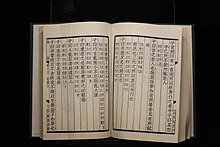
 A page from the Analects | |
| Author | Disciples of Confucius |
|---|---|
| Linguistic communication | Classical Chinese |
| Analects | |||||||||||||||||||||||||||||||||||||||||||||
|---|---|---|---|---|---|---|---|---|---|---|---|---|---|---|---|---|---|---|---|---|---|---|---|---|---|---|---|---|---|---|---|---|---|---|---|---|---|---|---|---|---|---|---|---|---|
 "Analects" in ancient seal script (summit), Traditional (middle), and Simplified (bottom) Chinese characters | |||||||||||||||||||||||||||||||||||||||||||||
| Traditional Chinese | 論語 | ||||||||||||||||||||||||||||||||||||||||||||
| Simplified Chinese | 论语 | ||||||||||||||||||||||||||||||||||||||||||||
| Hanyu Pinyin | Lúnyǔ | ||||||||||||||||||||||||||||||||||||||||||||
| Literal meaning | "Selected Sayings",[1] or "Edited Conversations"[2] | ||||||||||||||||||||||||||||||||||||||||||||
| |||||||||||||||||||||||||||||||||||||||||||||
The Analects (Chinese: 論語; pinyin: Lúnyǔ ; Onetime Chinese: [r]u[northward] ŋ(r)aʔ; significant "Selected Sayings"[i]), likewise known as the Analects of Confucius , the Sayings of Confucius , or the Lun Yu , is an ancient Chinese book composed of a big collection of sayings and ideas attributed to the Chinese philosopher Confucius and his contemporaries, traditionally believed to accept been compiled and written by Confucius's followers. Information technology is believed to have been written during the Warring States period (475–221 BC), and it achieved its concluding form during the mid-Han dynasty (206 BC–220 AD). By the early Han dynasty the Analects was considered but a "commentary" on the 5 Classics, but the status of the Analects grew to be one of the fundamental texts of Confucianism by the end of that dynasty.
During the tardily Vocal dynasty (960–1279 Advertising) the importance of the Analects as a Chinese philosophy work was raised above that of the older 5 Classics, and information technology was recognized as one of the "Four Books". The Analects has been i of the near widely-read and studied books in Prc for the concluding 2,000 years, and continues to take a substantial influence on Chinese and East Asian thought and values today.
Confucius believed that the welfare of a state depended on the moral cultivation of its people, commencement from the nation'southward leadership. He believed that individuals could brainstorm to cultivate an all-encompassing sense of virtue through ren, and that the nigh basic stride to cultivating ren was devotion to 1's parents and older siblings. He taught that one'south individual desires practice not need to be suppressed, but that people should be educated to reconcile their desires via rituals and forms of propriety, through which people could demonstrate their respect for others and their responsible roles in society.
Confucius taught that a ruler's sense of virtue was his primary prerequisite for leadership. His primary goal in educating his students was to produce ethically well-cultivated men who would bear themselves with gravity, speak correctly, and demonstrate complete integrity in all things.
History [edit]
Creation of the text [edit]

A portrait of Confucius giving a lecture.
According to Ban Gu, writing in the Book of Han, the Analects originated equally individual records kept by Confucius's disciples of conversations between the Master and them, which were then collected and jointly edited by the disciples after Confucius's death in 479 BC. The work is therefore titled Lunyu meaning "edited conversations" or "selected speeches" (i.e. analects).[2] [3] This broadly forms the traditional account of the genesis of the work accepted past later generations of scholars, for example the Song dynasty neo-Confucian scholar Zhu Eleven stated that Analects is the records of Confucius's first- and second-generation pupils.[4]
This traditional view has been challenged by Chinese, Japanese, and Western scholars. The Qing dynasty philologist Cui Shu argued on linguistic ground that the last five books were produced much after than the rest of the work. Itō Jinsai claimed that, considering of differences he saw in patterns of linguistic communication and content in the Analects, a distinction in authorship should be made between the "upper Analects" (Books 1–10) and "lower Analects" (Books 11–20). Arthur Waley speculated that Books 3–ix represent the earliest parts of the book. Due east. Bruce Brooks and A. Taeko Brooks reviewed previous theories of the chapters' creation and produced a "4 stratum theory" of the text's creation.[1] [v] Many modern scholars now believe that the piece of work was compiled over a period of around two hundred years, some fourth dimension during the Warring States flow (476–221 BC), with some questioning the actuality of some of the sayings.[6] [7] Considering no texts dated earlier than about fifty BC have been discovered, and because the Analects was not referred to by name in whatever existing source before the early on Han dynasty, some scholars accept proposed dates as late every bit 140 BC for the text'due south compilation.[8]
Regardless of how early on the text of the Analects existed, almost Analects scholars believe that by the early Han dynasty (206 BC–220 AD) the book was widely known and transmitted throughout Prc in a mostly complete form, and that the volume acquired its final, consummate course during the Han dynasty. Nonetheless, Han dynasty writer Wang Chong claimed that all copies of the Analects that existed during the Han dynasty were incomplete and formed only a part of a much larger work.[ix] This is supported by the fact that a larger collection of Confucius'southward teachings did be in the Warring States menstruation than has been preserved directly in the Analects: 75% of Confucius's sayings cited by his 2nd-generation student, Mencius, practice non exist in the received text of the Analects.[10]
Versions [edit]
According to the Han dynasty scholar Liu Xiang, there were 2 versions of the Analects that existed at the commencement of the Han dynasty: the "Lu version" and the "Qi version". The Lu version independent twenty chapters, and the Qi version contained twenty-two chapters, including two chapters not found in the Lu version. Of the twenty chapters that both versions had in common, the Lu version had more than passages. Each version had its own masters, schools, and transmitters.[11]
In the reign of Emperor Jing of Han (r. 157–141 BC), a third version (the "Old Text" version) was discovered subconscious in a wall of the home and then believed to be Confucius's when the home was in the procedure of being destroyed past Rex Gong of Lu (r. 153–128 BC) in order to expand the male monarch's palace. The new version did not contain the two extra chapters found in the Qi version, but it split 1 chapter plant in the Lu and Qi versions in two, and then information technology had twenty-ane capacity, and the order of the chapters was different.[11]
The old text version got its name because it was written in characters not used since the earlier Warring States period (i.due east. before 221 BC), when it was assumed to have been hidden.[12] According to the Han dynasty scholar Huan Tan, the old text version had four hundred characters different from the Lu version (from which the received text of the Analects is mostly based), and information technology seriously differed from the Lu version in 20-seven places. Of these twenty-seven differences, the received text merely agrees with the old text version in 2 places.[thirteen]
Over a century later, the tutor of the Analects to Emperor Cheng of Han, Zhang Yu (d. 5 BC), synthesized the Lu and Qi versions by taking the Lu version as authoritative and selectively adding sections from the Qi version, and produced a composite text of the Analects known every bit the "Zhang Hou Lun". This text was recognized by Zhang Yu's contemporaries and past subsequent Han scholars as superior to either individual version, and is the text that is recognized as the Analects today.[xi] The Qi version was lost for about 1800 years only re-constitute during the excavation of the tomb of Marquis of Haihun in 2011.[14] No complete copies of either the Lu version or the old text version of the Analects exist today,[12] though fragments of the erstwhile text version were discovered at Dunhuang.[thirteen]
Before the late twentieth century the oldest existing copy of the Analects known to scholars was constitute in the "Stone Classics of the Xinping Era", a copy of the Confucian classics written in stone in the one-time Eastern Han dynasty capital letter of Luoyang around 175 Advertizement. Archaeologists take since discovered two handwritten copies of the Analects that were written around 50 BC, during the Western Han dynasty. They are known as the "Dingzhou Analects", and the "Pyongyang Analects", subsequently the location of the tombs in which they were establish. The Dingzhou Analects was discovered in 1973, merely no transcription of its contents was published until 1997. The Pyongyang Analects was discovered in 1992. Academic access to the Pyongyang Analects has been highly restricted, and no academic study on information technology was published until 2009.[15]
The Dingzhou Analects was damaged in a burn down shortly after it was entombed in the Han dynasty. It was further damaged in an convulsion shortly after it was recovered, and the surviving text is just nether half the size of the received text of the Analects. Of the sections that survive, the Dingzhou Analects is shorter than the received Analects, implying that the text of the Analects was still in the process of expansion when the Dingzhou Analects was entombed. There was bear witness that "additions" may have been fabricated to the manuscript later it had been completed, indicating that the author may have become aware of at least i other version of the Analects and included "extra" cloth for the sake of completeness.[16]
The content of the Pyongyang Analects is similar to the Dingzhou Analects. Because of the secrecy and isolationism of the North Korean authorities, just a very cursory report of information technology has been made available to international scholars, and its contents are not completely known outside of North korea. Scholars do not agree most whether either the Dingzhou Analects or the Pyongyang Analects represent the Lu version, the Qi version, the old text version, or a different version that was independent of these 3 traditions.[16]
Importance within Confucianism [edit]
During nigh of the Han period the Analects was non considered one of the principal texts of Confucianism. During the reign of Han Wudi (141–87 BC), when the Chinese government began promoting Confucian studies, but the Five Classics were considered by the government to be canonical (jing). They were considered Confucian because Confucius was assumed to have partially written, edited, and/or transmitted them. The Analects was considered secondary as it was thought to be merely a collection of Confucius's oral "commentary" (zhuan) on the Five Classics.[17]
The political importance and popularity of Confucius and Confucianism grew throughout the Han dynasty, and by the Eastern Han the Analects was widely read by schoolchildren and anyone aspiring to literacy, and oft read before the 5 Classics themselves. During the Eastern Han, the heir apparent was provided a tutor specifically to teach him the Analects. The growing importance of the Analects was recognized when the 5 Classics was expanded to the "Seven Classics": the V Classics plus the Analects and the Classic of Filial Piety, and its status as one of the central texts of Confucianism continued to grow until the late Song dynasty (960–1279), when it was identified and promoted as one of the Four Books by Zhu Xi and generally accepted as being more insightful than the older Five Classics.[18]
The writing mode of the Analects besides inspired future Confucian writers. For example, Sui Dynasty writer Wang Tong's 中说 (Explanation of the Mean)[19] was purposely written to emulate the way of the Analects, a practice praised by Ming Dynasty philosopher Wang Yangming.[xx]
[edit]
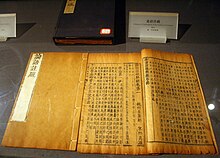
A copy of He Yan's commentary on the Analects, with a sub-commentary past Xing Bing, printed during the Ming dynasty
Since the Han dynasty, Chinese readers have interpreted the Analects by reading scholars' commentaries on the book. At that place have been many commentaries on the Analects since the Han dynasty, but the two which have been most influential have been the Collected Explanations of the Analects (Lunyu Jijie) by He Yan (c. 195–249) and several colleagues, and the Collected Commentaries of the Analects (Lunyu Jizhu) past Zhu Xi (1130–1200). In his work, He Yan collected, selected, summarized, and rationalized what he believed to be the most insightful of all preceding commentaries on the Analects which had been produced by before Han and Wei dynasty (220–265 AD) scholars.[21]
He Yan's personal interpretation of the Lunyu was guided by his conventionalities that Daoism and Confucianism complemented each other, so that by studying both in a correct manner a scholar could go far at a single, unified truth. Arguing for the ultimate compatibility of Daoist and Confucian teachings, he argued that "Laozi [in fact] was in agreement with the Sage" (sic). The Explanations was written in 248 AD, was quickly recognized equally authoritative, and remained the standard guide to interpreting the Analects for nearly i,000 years, until the early Yuan dynasty (1271–1368). Information technology is the oldest complete commentary on the Analects that notwithstanding exists.[21]
He Yan's commentary was somewhen displaced as the definitive, standard commentary past Zhu Xi's commentary. Zhu Xi'south piece of work also brought together the commentaries of earlier scholars (mostly from the Song dynasty), forth with his own interpretations. Zhu'south work took part in the context of a period of renewed interest in Confucian studies, in which Chinese scholars were interested in producing a unmarried "correct" intellectual orthodoxy that would "save" Chinese traditions and protect them from foreign influences, and in which scholars were increasingly interested in metaphysical speculation.[22]
In his commentary Zhu made a great try to translate the Analects by using theories elaborated in the other 4 Books, something that He Yan had not done. Zhu attempted to give an added coherence and unity to the message of the Analects, demonstrating that the individual books of the Confucian canon gave meaning to the whole, only as the whole of the canon gave meaning to its parts. In his preface, Zhu Xi stated, "[T]he Analects and the Mencius are the most of import works for students pursuing the Way [...] The words of the Analects are all inclusive; what they teach is nothing but the essentials of preserving the mind and cultivating [one's] nature."[23]
From the starting time publication of the Commentaries, Zhu continued to refine his interpretation for the terminal xxx years of his life. In the fourteenth century, the Chinese government endorsed Zhu's commentary. Until 1905 information technology was read and memorized along with the Analects by all Chinese aspiring to literacy and employment every bit government officials.[23]
Contents [edit]
Very few reliable sources nearly Confucius be besides that of the Analects. The primary biography available to historians is included in Sima Qian's Shiji, only because the Shiji contains a large corporeality of (possibly legendary) material non confirmed by extant sources, the biographical material on Confucius found in the Analects makes the Analects arguably the near reliable source of biographical information about Confucius.[24] Confucius viewed himself as a "transmitter" of social and political traditions originating in the early Zhou dynasty (c. m–800 BC), and claimed not to have originated anything (Analects vii.1), just Confucius'southward social and political ideals were not popular in his time.
[edit]
Confucius' discussions on the nature of the supernatural (Analects iii.12; vi.20; eleven.11) signal his belief that while "ghosts" and "spirits" should be respected, they are best kept at a distance. Instead human beings should base their values and social ideals on moral philosophy, tradition, and a natural love for others. Confucius' social philosophy largely depended on the cultivation of ren by every individual in a community.
Afterward Confucian philosophers explained ren as the quality of having a kind manner, similar to the English words "humane", "altruistic", or "benevolent", only, of the sixty instances in which Confucius discusses ren in the Analects, very few accept these later meanings. Confucius instead used the term ren to draw an extremely full general and extensive state of virtue, one which no living person had attained completely. (This apply of the term ren is peculiar to the Analects.)[26]
Throughout the Analects, Confucius's students oftentimes request that Confucius define ren and give examples of people who embody it, but Confucius generally responds indirectly to his students' questions, instead offering illustrations and examples of behaviours that are associated with ren and explaining how a person could achieve it. According to Confucius, a person with a well-cultivated sense of ren would speak carefully and modestly (Analects 12.iii); be resolute and house (Analects 12.20), courageous (Analects 14.four), gratuitous from worry, unhappiness, and insecurity (Analects 9.28; six.21); moderate their desires and return to propriety (Analects 12.1); exist respectful, tolerant, diligent, trustworthy and kind (Analects 17.6); and love others (Analects 12.22). Confucius recognized his followers' disappointment that he would not give them a more than comprehensive definition of ren, simply assured them that he was sharing all that he could (Analects vii.24).[27]
To Confucius, the tillage of ren involved depreciating oneself through modesty while avoiding artful spoken communication and ingratiating manners that would create a false impression of one'due south own character (Analects 1.3). Confucius said that those who had cultivated ren could be distinguished by their being "simple in manner and slow of speech." He believed that people could cultivate their sense of ren through exercising the inverted Golden Rule: "Do not do to others what you lot would not like washed to yourself"; "a human being with ren, desiring to establish himself, helps others establish themselves; desiring to succeed himself, helps others to succeed" (Analects 12.2; 6.28).
Confucius taught that the ability of people to imagine and projection themselves into the places of others was a crucial quality for the pursuit of moral self-cultivation (Analects 4.15; run across likewise v.12; 6.30; 15.24).[28] Confucius regarded the exercise of devotion to ane'due south parents and older siblings as the simplest, most bones style to cultivate ren. (Analects one.2).
Confucius believed that ren could best exist cultivated by those who had already learned cocky-discipline, and that self-subject was best learned by practicing and cultivating one's understanding of li: rituals and forms of propriety through which people demonstrate their respect for others and their responsible roles in society (Analects three.3). Confucius said that one'southward agreement of li should inform everything that one says and does (Analects 12.1). He believed that subjecting oneself to li did not mean suppressing one's desires, but learning to reconcile them with the needs of i's family and broader customs.
By leading individuals to limited their desires within the context of social responsibility, Confucius and his followers taught that the public cultivation of li was the basis of a well-ordered society (Analects 2.3). Confucius taught his students that an important aspect of li was observing the practical social differences that exist betwixt people in daily life. In Confucian philosophy these "5 relationships" include: ruler to ruled; father to son; husband to wife; elderberry brother to younger brother; and friend to friend.
Ren and li accept a special relationship in the Analects: li manages ane'south human relationship with one'southward family and close customs, while ren is practiced broadly and informs 1's interactions with all people. Confucius did not believe that upstanding cocky-tillage meant unquestioned loyalty to an evil ruler. He argued that the demands of ren and li meant that rulers could oppress their subjects only at their own peril: "You lot may rob the Three Armies of their commander, just you cannot deprive the humblest peasant of his opinion" (Analects ix.26). Confucius said that a morally well-cultivated individual would regard his devotion to loving others as a mission for which he would be willing to die (Analects 15.8).
Political philosophy [edit]
Confucius' political beliefs were rooted in his belief that a practiced ruler would exist cocky-disciplined, would govern his subjects through education and by his own instance, and would seek to correct his subjects with honey and concern rather than punishment and coercion. "If the people be led by laws, and uniformity among them be sought past punishments, they will endeavour to escape punishment and have no sense of shame. If they are led by virtue, and uniformity sought among them through the practice of ritual propriety, they will possess a sense of shame and come to y'all of their own accordance" (Analects 2.3; see too xiii.6). Confucius' political theories were directly contradictory to the Legalistic political orientations of Red china's rulers, and he failed to popularize his ideals among Prc'southward leaders within his own lifetime.[29]
Confucius believed that the social chaos of his fourth dimension was largely due to China's ruling aristocracy aspiring to, and claiming, titles of which they were unworthy. When the ruler of the large state of Qi asked Confucius almost the principles of skilful government, Confucius responded: "Practiced government consists in the ruler being a ruler, the minister being a government minister, the father being a male parent, and the son being a son" (Analects 12.11).
The analysis of the need to enhance officials' behavior to reflect the way that they identify and describe themselves is known every bit the rectification of names, and he stated that the rectification of names should exist the first responsibleness of a ruler upon taking office (Analects xiii.3). Confucius believed that, considering the ruler was the model for all who were under him in guild, the rectification of names had to begin with the ruler, and that afterwards others would modify to imitate him (Analects 12.19).[29]
Confucius judged a adept ruler past his possession of de ("virtue"): a sort of moral force that allows those in power to rule and gain the loyalty of others without the demand for physical compulsion (Analects 2.1). Confucius said that i of the most important ways that a ruler cultivates his sense of de is through a devotion to the correct practices of li. Examples of rituals identified by Confucius as of import to cultivate a ruler's de include: sacrificial rites held at ancestral temples to express thankfulness and humility; ceremonies of enfeoffment, toasting, and gift exchanges that spring nobility in complex hierarchical relationships of obligation and indebtedness; and, acts of formal politeness and decorum (i.e. bowing and yielding) that place the performers equally morally well-cultivated.[29]
Educational activity [edit]
The importance of education and study is a fundamental theme of the Analects. For Confucius, a skilful student respects and learns from the words and deeds of his teacher, and a adept teacher is someone older who is familiar with the ways of the past and the practices of antiquity (Analects 7.22). Confucius emphasized the need to find remainder between formal study and intuitive self-reflection (Analects 2.15). When teaching he is never cited in the Analects as lecturing at length nigh any subject, but instead challenges his students to discover the truth through asking direct questions, citing passages from the classics, and using analogies (Analects 7.8).[30] He sometimes required his students to demonstrate their agreement of subjects by making intuitive conceptual leaps before accepting their understanding and discussing those subjects at greater levels of depth. (Analects 3.8)[31]
His principal goal in educating his students was to produce ethically well-cultivated men who would behave themselves with gravity, speak correctly, and demonstrate consummate integrity in all things (Analects 12.11; run into besides thirteen.3). He was willing to teach anyone regardless of social class, as long as they were sincere, eager, and tireless to learn (Analects vii.7; 15.38). He is traditionally credited with teaching three chiliad students, though only seventy are said to have mastered what he taught. He taught practical skills, but regarded moral self-cultivation equally his well-nigh of import bailiwick.[xxx]
Chapters [edit]
The traditional titles given to each chapter are mostly an initial two or three incipits. In some cases a title may indicate a central theme of a chapter, but information technology is inappropriate to regard a title every bit a description or generalization of the content of a affiliate. Chapters in the Analects are grouped by individual themes, but the capacity are non arranged in a way as to behave a continuous stream of thoughts or ideas. The themes of adjacent capacity are completely unrelated to each other. Central themes recur repeatedly in unlike chapters, sometimes in exactly the aforementioned wording and sometimes with small variations.
Affiliate ten contains detailed descriptions of Confucius's behaviors in various daily activities. Voltaire and Ezra Pound believed that this chapter demonstrated how Confucius was a mere human. Simon Leys, who recently translated the Analects into English and French, said that the book may have been the showtime in human history to draw the life of an private, historic personage. Elias Canetti wrote: "Confucius's Analects is the oldest consummate intellectual and spiritual portrait of a human. It strikes one as a modern volume; everything information technology contains and indeed everything information technology lacks is important."[32]
Affiliate 20, "Yao Yue", particularly the outset verse, is baroque in terms of both language and content. In terms of linguistic communication, the text appears to be primitive (or a deliberate fake of the archaic language of the Western Zhou) and bears some similarity with the linguistic communication of the speeches in the Shujing.[33] [34] [ page needed ] In terms of the content, the passage appears to be an admonition past Yao to Shun on the eve of Yao's abdication, which seems to be only tangentially related to Confucius and his philosophy. Moreover, in that location appear to be some bug with the text's continuity, and scholars accept speculated that parts of the text were lost in the process of manual and maybe transmitted with errors in the order.[35] The fragmentary nature of the concluding chapter of the received Lu text has been explained past the "accretion theory", in which the text of the Analects was gradually accreted over a 230-yr period, start with the death of Confucius and ending suddenly with the conquest of Lu in 249 BCE.[36]
Within these incipits a big number of passages in the Analects begin with the formulaic ziyue, "The Chief said," only without punctuation marks in classical Chinese, this does non ostend whether what follows ziyue is direct quotation of actual sayings of Confucius, or but to be understood as "the Master said that.." and the paraphrase of Confucius past the compilers of the Analects.[37]
| Volume | Championship | Translation | Notes |
|---|---|---|---|
| 1. | Xue Er 學而 | Studying and Practicing | |
| 2. | Wei Zheng 為政 | The practice of government | This chapter explores the theme that political order is best gained through the non-coercive influence of moral self-tillage rather than through force or excessive government regulation.[38] |
| 3. | Ba Yi 八佾 | Eight lines of eight dancers apiece | Ba Yi was a kind of ritual dance practiced in the court of the Zhou male monarch. In Confucius' time, bottom nobles also began staging these dances for themselves. The main themes of this chapter are: criticism of ritual impropriety (especially among China'due south political leadership), and the demand to combine learning with nature in the course moral self-cultivation.[39] Chapters three–9 may be the oldest in the Analects.[forty] |
| 4. | Li Ren 里仁 | Living in brotherliness | This chapter explores the theme of ren, its qualities, and the qualities of those who have it. A secondary theme is the virtue of filial piety.[41] |
| 5. | Gongye Chang 公冶長 | Gongye Chang | The main theme of this chapter is Confucius' exam of others' qualities and faults in order to illustrate the desirable class of moral self-cultivation.[42] This chapter has traditionally been attributed to the disciples of Zigong, a student of Confucius.[43] Gongye Chang was Confucius' son-in-constabulary.[44] |
| 6. | Yong Ye 雍也 | There is Yong | Yong is Ran Yong, as well called Zhou Gong, a disciple of Confucius. |
| 7. | Shu Er 述而 | Transmission | Transmission, not invention [of learning]. |
| eight. | Taibo 泰伯 | Taibo | Wu Taibo was the legendary founder of the state of Wu. He was the oldest son of Male monarch Tai and the uncle of Male monarch Wen of the Zhou Dynasty. |
| 9. | Zi Han 子罕 | The Master shunned | Confucius seldom spoke of advantage. |
| x. | Xiang Dang 鄉黨 | Amidst the Xiang and the Dang | A "xiang" was a group of 12,500 families; a "dang" a grouping of 500 families. This affiliate is a drove of maxims related to ritual.[40] |
| 11. | Xian Jin 先進 | Those of former eras | The erstwhile generations. This chapter has traditionally been attributed to the disciples of Min Dominicus (Min Ziqian), a pupil of Confucius.[43] |
| 12. | Yan Yuan 顏淵 | Yan Yuan | Yan Hui was a common name of Zi Yuan, the favorite disciple of Confucius. |
| 13. | Zilu 子路 | Zilu | Zilu was a student of Confucius. |
| xiv. | Xian Wen 憲問 | Xian asked | This chapter has traditionally been attributed to the disciples of Yuan Xian, likewise called both Yuan Si and Zisi, a pupil of Confucius.[43] |
| fifteen. | Wei Ling Gong 衛靈公 | Duke Ling of Wey | Duke Ling ruled from 534–493 BC in the state of Wey. |
| 16. | Ji Shi 季氏 | Chief of the Ji Clan | Jisun was an official from one of the most of import families in Lu. This chapter is generally believed to have been written relatively tardily;[twoscore] possibly compiled from the extra chapters of the Qi version of the Analects.[43] |
| 17. | Yang Huo 陽貨 | Yang Huo | Yang was an official of the Ji association, an important family in Lu. |
| eighteen. | Weizi 微子 | Weizi | Weizi was the older half-brother of Zhou, the last king of the Shang dynasty, and was founder of the country of Song. The writer of this affiliate was disquisitional of Confucius.[40] |
| 19. | Zizhang 子張 | Zizhang | Zizhang (Zhuansun Shi) was a student of Confucius. This chapter consists entirely of sayings by Confucius' disciples.[forty] |
| 20. | Yao Yue 堯曰 | Yao spoke | Yao was ane of the traditional Iii Sovereigns and Five Emperors of ancient China. This chapter consists entirely of stray sentences resembling the fashion and content of the Shujing.[40] |
Notable translations [edit]
- Legge, James, trans. (1861). Confucian Analects, the Peachy Learning, and the Doctrine of the Mean. The Chinese Classics. Vol. I. London: Trübner. Revised second edition (1893), Oxford: Clarendon Press, reprinted by Cosimo in 2006. ISBN 978-1-60520-643-1
- Lyall, Leonard A., trans. (1909). The Sayings of Confucius. London: Longmans, Green and Co. OCLC 1435673.
- Soothill, William Edward, trans. (1910). The Analects of Confucius. Yokohama: Fukuin Printing. ; rpt. London: Oxford University Press (1937).
- Couvreur, Séraphin, trans. (1930). Entretiens de Confucius [Conversations of Confucius]. Les Quatre Livres (in French) (3rd ed.). Sien Hsien: Mission Catholique.
- Waley, Arthur, trans. (1938). The Analects. London: George Allen and Unwin. Archived from the original on 2015-06-16. Retrieved 2011-09-21 . Rpt. (2000), New York: Alfred A. Knopf. ISBN 978-0-375-41204-2
- (in Japanese) Yoshikawa, Kōjirō 吉川幸次郎 (1978). Rongo 論語 [Lunyu], iii vols. Tokyo: Asahi Shinbun. Rpt. 2 vols, Asahi Shinbun (1996).
- Lau, D. C., trans. (1979). Confucius, The Analects (Lun yü). Harmondsworth: Penguin Books. ; rpt. with Chinese text, Hong Kong: Chinese University Press (1979).
- Cheng, Anne, trans. (1981). Entretiens de Confucius [Conversations of Confucius] (in French). Paris: Éditions du Seuil.
- Ryckmans, Pierre, trans. (1987). Les Entretiens de Confucius [The Conversations of Confucius] (in French). Paris: Gallimard. English version published equally Simon Leys, trans. (1997), The Analects of Confucius (New York: West. W. Norton).
- Huang, Chi-chung, trans. (1997). The Analects of Confucius. Oxford: Oxford Academy Press. ISBN978-0195112764.
- Leys, Simon, trans. (1997). The Analects of Confucius. New York: W.W. Norton and Co. ISBN978-0393316995.
- Ames, Roger T.; Rosemont, Henry, trans. (1999). The Analects of Confucius: A Philosophical Translation. New York: Ballantine Books (Penguin Random Firm). ISBN978-0345434074.
- Brooks, E. Bruce; Brooks, Taeko, trans. (2001). The Original Analects: Sayings of Confucius and His Followers. New York: Columbia University Printing. ISBN978-0231104302.
- Slingerland, Edward, trans. (2003). Analects of Confucius: With Selections from Traditional Commentaries. Cambridge: Hackett Publishing Company. ISBN978-0872206359.
- Watson, Burton, trans. (2007). The Analects of Confucius. New York: Columbia University Press. ISBN978-0-231-14164-two.
See too [edit]
- Kongzi Jiayu, sayings of Confucius not included in the Analects
- Chinese archetype texts
- Sacred text
- Virtue jurisprudence
- Disciples of Confucius
- Hadith
- Mahāvākyas
- The Maxims of Ptahhotep
References [edit]
Citations [edit]
- ^ a b c Van Norden (2002), p. 12.
- ^ a b Knechtges & Shih (2010), p. 645.
- ^ Kim & Csikszentmihalyi (2010), p. 25.
- ^ Kim & Csikszentmihalyi (2013), p. 26.
- ^ Slingerland (2003), pp. thirteen–xiv.
- ^ Lee Dian Rainey (2010). Confucius and Confucianism: The Essentials. Wiley-Blackwell. p. 10. ISBN978-1444323603.
- ^ Robert Eno (2015). "The Analects of Confucius" (PDF). Indiana University.
- ^ van Els (2012), pp. 21–23.
- ^ Kim & Csikszentmihalyi (2010), pp. 25–26.
- ^ Waley (1938), p. 23.
- ^ a b c Gardner (2003), pp. seven, xv–16.
- ^ a b van Els (2012), p. 20.
- ^ a b Waley (1938), p. 24.
- ^ China Daily
- ^ van Els (2012), pp. ane–2.
- ^ a b van Els (2012), pp. six, 10–xi, 20–21.
- ^ Gardner (2003), p. 7.
- ^ Gardner (2003), pp. 8, 18–19.
- ^ Explanation on the Mean (中說)
- ^ Ivanhoe, Philip (2009). Readings from the Lu-Wang school of Neo-Confucianism. Indianapolis: Hackett Pub. Co. p. 149. ISBN978-0872209602.
- ^ a b Gardner (2003), pp. 8, xiii–14.
- ^ Gardner (2003), pp. eighteen–20, 46.
- ^ a b Gardner (2003), pp. 7–viii, 21, 46.
- ^ Lau (2002), p. 9.
- ^ Waley (1938), pp. 27–29.
- ^ Gardner (2003), pp. 52–53.
- ^ Slingerland (2003), p. 34.
- ^ a b c Riegel (2012), "3. Confucius' Political Philosophy".
- ^ a b Riegel (2012), "iv. Confucius and Education".
- ^ Slingerland (2003), pp. 19–20.
- ^ Canetti 1984, p. 173.
- ^ Schaberg, David; Ames, Roger T.; Rosemont, Henry; Lau, D. C.; Dawson, Raymond; Leys, Simon; Huang, Chichung; Hinton, David; Brooks, E. Bruce (December 2001). ""Sell it! Sell it!": Contempo Translations of Lunyu". Chinese Literature: Essays, Articles, Reviews (CLEAR). 23: 115–139. doi:10.2307/495503. JSTOR 495503.
- ^ Van Norden (2002).
- ^ Confucius.; 孔子. (2008). The analects, translated by Yang Bojun, D.C. Lau = Lun yu. Yang, Bojun; Lau, D. C. (Dim Cheuk), 杨伯峻., 刘殿爵. (Beijing di 1 ban ed.). Beijing Shi: Zhong hua shu ju. ISBN978-7101062281. OCLC 269201157.
- ^ Slingerland, Edward (2000). Brooks, E. Bruce; Brooks, A. Taeko (eds.). "Why Philosophy Is Not "Actress" in Agreement the Analects". Philosophy East and West. 50 (i): 137–141. ISSN 0031-8221. JSTOR 1400076.
- ^ Roger T. Ames The Analects of Confucius: A Philosophical Translation 2010 p. 285 "A large number of passages in the Analects brainstorm with the formulaic ziyue 子曰, "The Main said," only considering there are no punctuation marks in classical Chinese, we must ask if whatever follows ziyue is a literal transcription of speech, or a paraphrase of it, or a method of transmitting ideas in a written language which existed in important ways independently of the spoken linguistic communication."
- ^ Slingerland (2003), p. eight.
- ^ Slingerland (2003), p. 17.
- ^ a b c d e f Waley (1938), p. 21.
- ^ Slingerland (2003), p. 29.
- ^ Slingerland (2003), p. 39.
- ^ a b c d Legge (2009), p. 16.
- ^ Legge (2009), p. 119.
Sources [edit]
- Canetti, Elias (1984). The Conscience of Words. Translated by Neugroschel, Joachim. Farrar Straus Giroux. ISBN0374518815.
- Cheng, Anne (1993). "Lun yü 論語". In Loewe, Michael (ed.). Early Chinese Texts: A Bibliographical Guide. Berkeley: Society for the Study of Early Mainland china; Plant for East Asian Studies, University of California, Berkeley. pp. 313–323. ISBN978-1-55729-043-4.
- Gardner, Daniel K (2003). Zhu Xi's Reading of the Analects: Canon, Commentary, and the Classical Tradition. New York: Columbia University Press. ISBN978-0-231-12865-0.
- People's republic of china Daily. "Qi Version of 'Analects of Confucius' Discovered in Haihunhou Tomb". Chinese Archaeology. Jan 13, 2017. Retrieved April 17, 2019.
- van Els, Paul (2012). "Confucius' sayings entombed: On Ii Han Dynasty Analects Manuscripts" (PDF). Analects Studies. Leiden: Brill. Archived from the original (PDF) on 2015-x-03.
- Kern, Martin (2010). "Early Chinese literature, Beginnings through Western Han". In Owen, Stephen (ed.). The Cambridge History of Chinese Literature, Book one: To 1375. Cambridge: Cambridge University Press. pp. i–115. ISBN978-0-521-11677-0.
- Kim, Tae Hyun; Csikszentmihalyi, Marking (2010). "Affiliate 2". In Olberding, Amy (ed.). Dao Companion to the Analects. Springer. pp. 21–36. ISBN978-9400771123.
- Knechtges, David R.; Shih, Hsiang-ling (2010). "Lunyu 論語". In Knechtges, David R.; Chang, Taiping (eds.). Ancient and Early Medieval Chinese Literature: A Reference Guide, Function One. Leiden: Brill. pp. 645–650. ISBN978-90-04-19127-3.
- Lau, D.C. (2002). "Introduction". The Analects. Hong Kong: The Chinese University Press. ISBN962-201-980-3.
- Legge, James (2009). "Prolegomena". The Confucian Analects, The Great Learning, and The Doctrine of the Mean. New York: Cosimo. ISBN978-1-60520-644-8.
- Van Norden, Bryan (2002). Confucius and the Analects : New Essays. New York: Oxford University Press. ISBN978-0195350821. OCLC 466432745.
- Riegel, Jeffrey (Spring 2012). "Confucius". In Zalta, Edward N. (ed.). The Stanford Encyclopedia of Philosophy.
- Kim, Tae Hyun; Csikszentmihalyi, Mark (2013). "Chapter 2". In Olberding, Amy (ed.). Dao Companion to the Analects. Springer. pp. 21–36. ISBN978-9400771123.
- Slingerland, Edward (2003). Analects: With Selections from Traditional Commentaries. Indianapolis: Hackett. ISBN978-1603843454.
- Waley, Arthur. "Terms". In The Analects of Confucius. Trans. Arthur Waley. New York: Vintage Books. 1938.
Farther reading [edit]
- Van Norden, Bryan W. Confucius and the Analects : New Essays. Oxford University Press, 2001. ISBN 978-0195350821.
- The Analects at the Database of Religious History.
External links [edit]
 | Wikiquote has quotations related to: Analects |
 | Look up analects in Wiktionary, the free lexicon. |
 | Chinese Wikisource has original text related to this article: |
-
 The Analects of Confucius public domain audiobook at LibriVox
 - Bilingual excerpts and children's sound in Chinese and Japanese.
- Chinese-English bilingual text (Legge'due south translation) with links to Zhu Xi's commentary, at Chinese Text Project.
- English translation by A. Charles Muller, with Chinese text.
- English language translation at Confucius.org, one page per verse.
- English translation at MIT Classics
- Latin translation (Zottoli, 1879)
- Legge's English translation from the University of Adelaide Library (no department numbers)
- Multilingual edition of the Analects in Chinese, English language and French
- Translations of the Analects in over 20 languages, with footnotes.
Source: https://en.wikipedia.org/wiki/Analects
0 Response to "Zhu Xi's Reading of the Analects: Canon, Commentary, and the Classical Tradition"
Post a Comment